

Your People Are the Operating System
Recently, I needed to map two company's sellers to a list of leads. This is exactly the kind of tedious work AI should be good at.
We had seller directories. We had territories. We had company information. Instead of asking someone to spend hours matching the lists manually, AI could do the first pass.
And it did. Then we looked at the results.
A lead located in the UK had been mapped to a UK seller. Reasonable.
Except the company could be Boeing.
The employee may be sitting in London. The global account may be owned in the United States.
The AI hadn't made a stupid inference. It had made a perfectly reasonable inference from the information available to it.
The system didn't contain enough of the operating context required to make the right decision.
And suddenly I could see a much bigger problem.
AI can automate what the system makes legible
Enterprise work contains enormous amounts of context that formal systems don't fully represent.
Who actually owns the account.
Why this campaign was designed this way.
Which executive cares about the relationship.
Which process you're supposed to use.
Which process actually works.
Who can get something approved.
Why the obvious option was rejected six months ago.
Which partner will interpret a decision as an escalation.
Which seller knows the customer.
Which exception exists because of something that happened three fiscal years ago.
Organizations have always depended on this kind of knowledge.
Research on organizational knowledge distinguishes between knowledge that can be articulated explicitly and knowledge that remains more tacit. Ikujiro Nonaka's foundational work argued that organizations create knowledge through interactions between tacit and explicit forms, with organizations playing a role in articulating and amplifying knowledge developed by individuals.
James Walsh and Gerardo Ungson approached a related problem through organizational memory: how organizations acquire, retain and retrieve information from their history.
Thirty years later, this problem is becoming an AI problem, because AI inherits the organization's information architecture. If important operating context exists only in people, AI can't reliably reason over it.
The present is an accumulation of decisions
When I left a previous role, I wrote roughly 60 pages for the person replacing me. Then I built an AI agent on top of it.
I cared about the handoff for an unusual reason: I was moving to another company, and my old company was becoming one of my partners. I had a direct interest in my replacement succeeding.
So I tried to document everything. Not just the formal process. The actual process. The history. The things we had tried. Why certain decisions had been made. The unofficial rules. The things everyone “knew” but nobody had written down. The heresies.
The context someone would otherwise spend a year slowly accumulating.
Because when you step into a role, the present is an accumulation of decisions that only understanding the past can explain.
And most enterprise systems are surprisingly bad at preserving that explanation.
They preserve artifacts:
The deck.
The campaign.
The opportunity.
The email.
The approval.
The spreadsheet.
They don't necessarily preserve the causal story connecting them.
Humans do.
Relationships aren't the problem
The argument is not that relationships are inefficient legacy infrastructure we should automate away.
Research on interorganizational governance provides a useful warning against that conclusion.
Laura Poppo and Todd Zenger studied formal contracts and relational governance in interorganizational exchanges and found evidence that they can function as complements, rather than one simply replacing the other. Formal mechanisms and relationships can reinforce each other.
That matches my experience.
Strong partnerships need humans. They need trust, judgment, negotiation, creativity, leadership, empathy.
The ability to understand something nobody has encountered before.
The willingness to try something that doesn't yet have a process.
The problem isn't that partnerships run on relationships. They should. The problem is what we're asking those relationships to do.
Humans are doing middleware work
I've watched a person schedule nearly 100 individual seller meetings between two companies because that was the mechanism available for connecting leads to the right people.
Spreadsheet. Email. Meeting invite. Reschedule. No-show. Follow-up. Repeat.
I've watched formal ticketing processes coexist with an unofficial alternative: know the person who handles the request. Message them. It gets done.
I've inherited campaigns where understanding the current state required reconstructing why dozens of decisions had been made months earlier.
None of this work is inherently irrational.
In fact, it is usually rational adaptation by intelligent people operating inside fragmented systems.
But look at what the human is doing.
Carrying state.
Routing information.
Resolving identity.
Translating between systems.
Remembering history.
Tracking dependencies.
Reconciling exceptions.
Maintaining context.
Connecting people.
Following up when the workflow has no enforcement mechanism. That is infrastructure work.
And we have quietly embedded enormous amounts of it inside human relationships.
Now we're adding AI to every box
Imagine the enterprise as a collection of systems. CRM, marketing automation, co-sell platforms, content systems, email, collaboration tools, sales systems, analytics, each one gets AI.
The content system generates faster. The CRM analyzes faster. Marketing launches faster. Sales researches faster. Analytics reports faster. Every individual stove burns hotter.
And sitting in the middle is a human being carrying context between them.
We keep pouring AI into the nodes.
We haven't necessarily redesigned the architecture between the nodes.
In fact, making each node dramatically more productive may increase the amount of coordination the system requires.
More content.
More campaigns.
More insights.
More possible partner combinations.
More signals.
More decisions.
More things that can happen.
That's not an argument against AI.
It's an argument for following AI's impact one level higher.
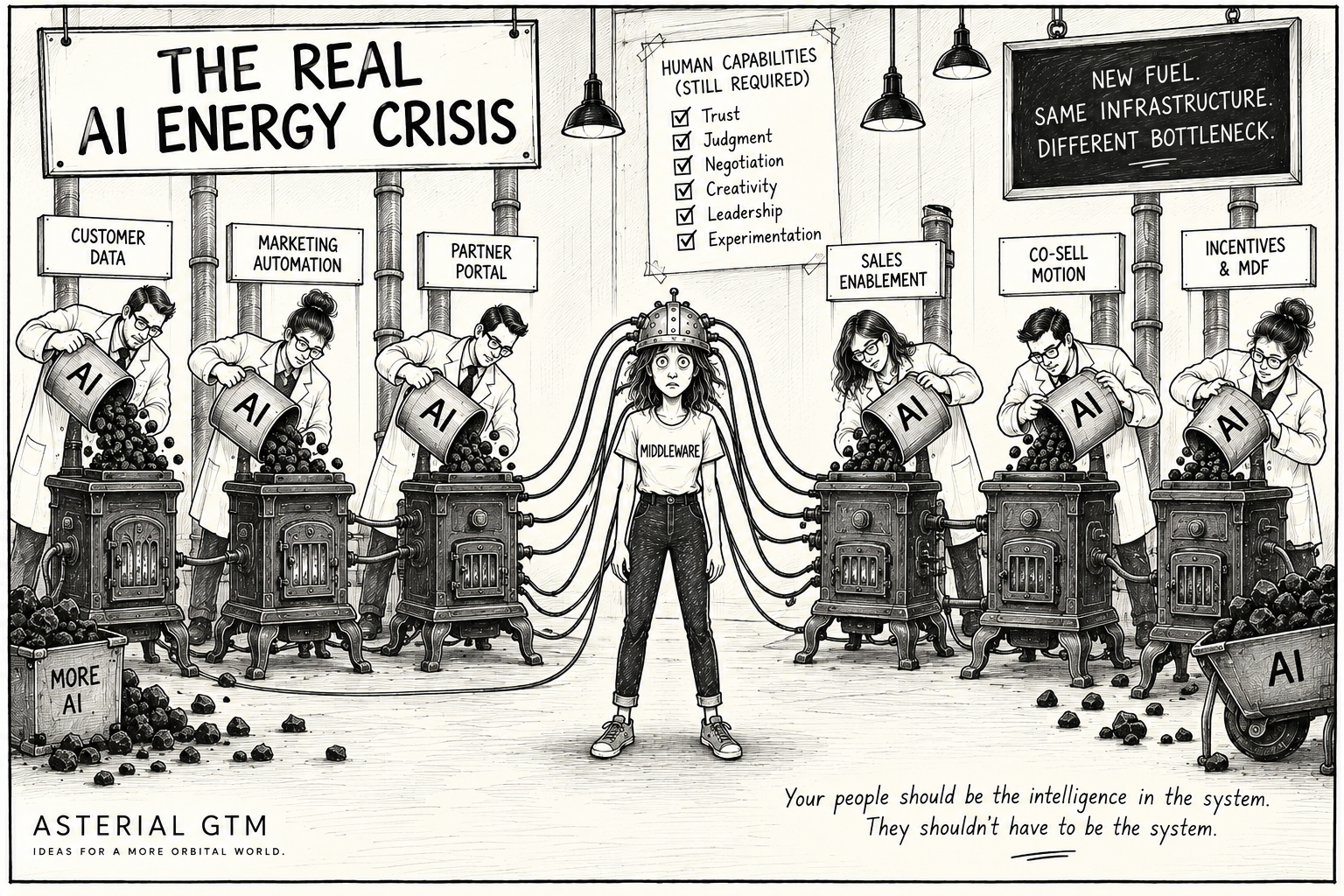
“The Real AI Energy Crisis.” We’re pouring powerful new fuel into old enterprise infrastructure while humans remain the integration layer connecting it all. Concept and direction by Megan Arnold; image created with ChatGPT.
What should humans actually be doing?
If we could remove enough of the integration work, I don't think the goal should be to remove the humans.
I'd want them doing more of the work we're actually good at: leading people, building trust, managing change, communicating meaning, experimenting, learning hard lessons, being accountable.
Negotiating the genuinely difficult tradeoffs between organizations that want different things. And making judgments where the available information cannot produce an obvious answer.
The infrastructure should remember the history.
It should carry state.
It should know the workflow.
It should surface dependencies.
It should make ownership visible.
It should route information.
It should preserve context.
It should make the work legible enough that AI can actually help.
Then the humans can do the human part.
Because your people should be the intelligence in the system.
They shouldn't have to be the system.
Research behind this essay
Nonaka, A Dynamic Theory of Organizational Knowledge Creation (1994); Walsh & Ungson, Organizational Memory (1991); Poppo & Zenger, Do Formal Contracts and Relational Governance Function as Substitutes or Complements? (2002).
