

We Digitized the Beads. We Never Digitized the String.
I recently worked on a global event series spanning multiple cities and regions.
Every location had its own moving pieces: dates, speakers, booth staffing, lead capture, swag, creative, localization, and different event requirements.
None of this information was missing. That was the problem - it was everywhere.
Some lived in email. Some in Teams conversations and meeting recordings. Some in planning decks, shared folders, spreadsheets, and different versions of assets. Different people knew different pieces.
We had successfully digitized almost everything.
But there was no place that represented the actual state of the campaign.
If I wanted to know what was happening in a particular market, I had to reconstruct it.
Which speakers were confirmed? Had the creative been localized? Who was staffing the event? Were the right assets ready? What was still blocked?
The answers existed.
The campaign didn't.
We digitized the beads
Enterprise software is very good at storing things.
Emails. Files. Tasks. Contacts. Opportunities. Conversations. Presentations. Recordings.
Think of each as a bead.
Over the last several decades, we've gotten extraordinarily good at digitizing them.
But my brain was still holding the string.
A surprising amount of my work wasn't actually creating any of those artifacts. It was maintaining an understanding of how they related to one another.
And then repeatedly explaining that understanding to other people so they could place their bead in the right spot.
The campaign existed as a coherent object largely because humans were continuously reconstructing it and ensuring we were all visualizing the same necklace (i.e. “aligning”).
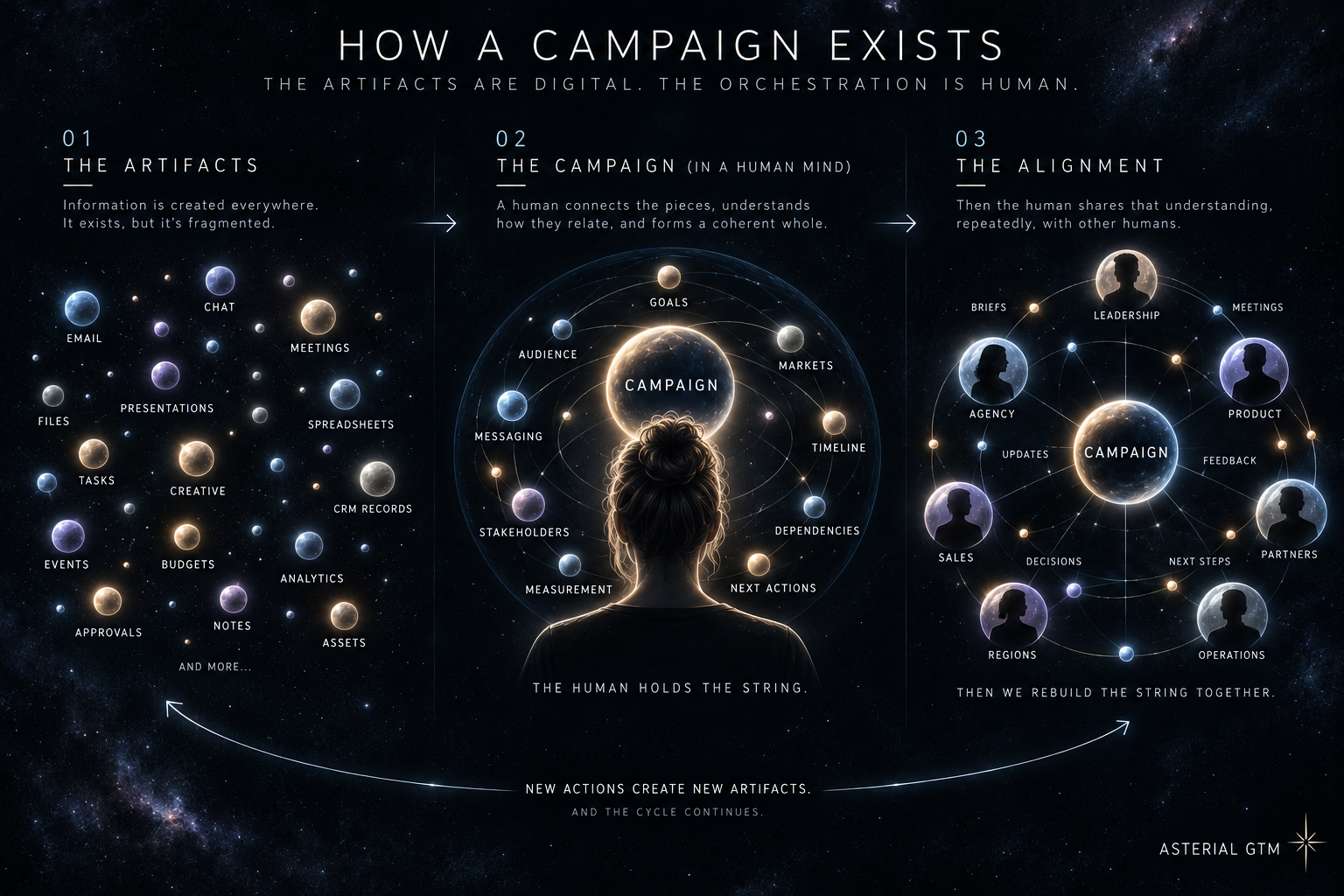
The artifacts are digital. The orchestration is human. A campaign exists because people continuously connect fragmented information into a coherent whole—and then synchronize that understanding with each other. Concept and direction by Megan Arnold; image created with ChatGPT.
Communication isn't the same as coordination
Research on shared mental models and transactive memory has long examined how teams coordinate by developing shared understandings of the work and knowledge of who knows what. Research on the “hidden profile” problem has similarly shown how information distributed across group members can remain difficult for the group to integrate.
More communication doesn't automatically solve that.
You can have more meetings, more messages, more documents and more dashboards while still lacking a shared representation of what is happening now.
That's the gap I find interesting for AI.
I built a Copilot-based tool that let me ask questions about the event series across the information already available to me.
Suddenly I could ask:
What's happening in this market? What's confirmed? What's missing? What changed?
It wasn't valuable because AI created another artifact.
It was valuable because it helped reconstruct the work itself from the artifacts surrounding it.
That feels like an important distinction.
For years, enterprise software has largely asked us to navigate to the places where information lives.
Open the CRM. Find the email. Search the chat. Locate the deck. Check the spreadsheet. Ask the person.
AI gives us an opportunity to invert that relationship.
Stop showing me the artifacts. Show me the work.
A campaign shouldn't exist only as a collection of files, messages, tasks and memories.
Neither should a product launch, a customer initiative, or a partnership.
Before we build agents to do more of the work, we may need systems that understand what the work is.
Because digitizing every bead isn't the same thing as knowing how they form the necklace.
