

AI Made Me Faster. The Work Still Took Two Weeks.
Recently, I had a marketing problem across about a dozen strategic accounts.
I had customer context scattered across calls, notes and other sources, and I wanted an agency to come back with campaign ideas grounded in what was actually happening inside those accounts.
Historically, getting them started would have been work in itself.
Gather the context. Synthesize it. Write the brief. Explain the accounts. Package everything so someone outside the day-to-day work could understand the problem.
Instead, I used Copilot.
Within minutes, I had synthesized the relevant context and turned it into a usable creative brief.
This is the kind of AI productivity gain we're all talking about.
Then I sent it to the agency.
The meeting was scheduled for two weeks later.
When we finally met, much of the conversation consisted of questions that could have been answered asynchronously. Notes were taken by hand. And when the hour was over, we still hadn't meaningfully advanced the work.
AI had dramatically increased the speed at which I could operate.
The work still took two weeks.
That's the problem I'm increasingly interested in.
We tend to think about AI productivity at the level of the individual task.
How much faster can I write this brief?
Analyze this data?
Build this presentation?
Research this customer?
But most go-to-market work doesn't happen inside one task, or even inside one person's job.
It moves from:
Marketing to agency.
Product to marketing.
Global to regional.
Vendor to partner.
Marketing to sales.
Sales back to product.
Every transition introduces some combination of waiting, context transfer, prioritization, interpretation, approval and rework.
Make one step 10x faster and the system doesn't necessarily become 10x faster.
It may barely move at all.
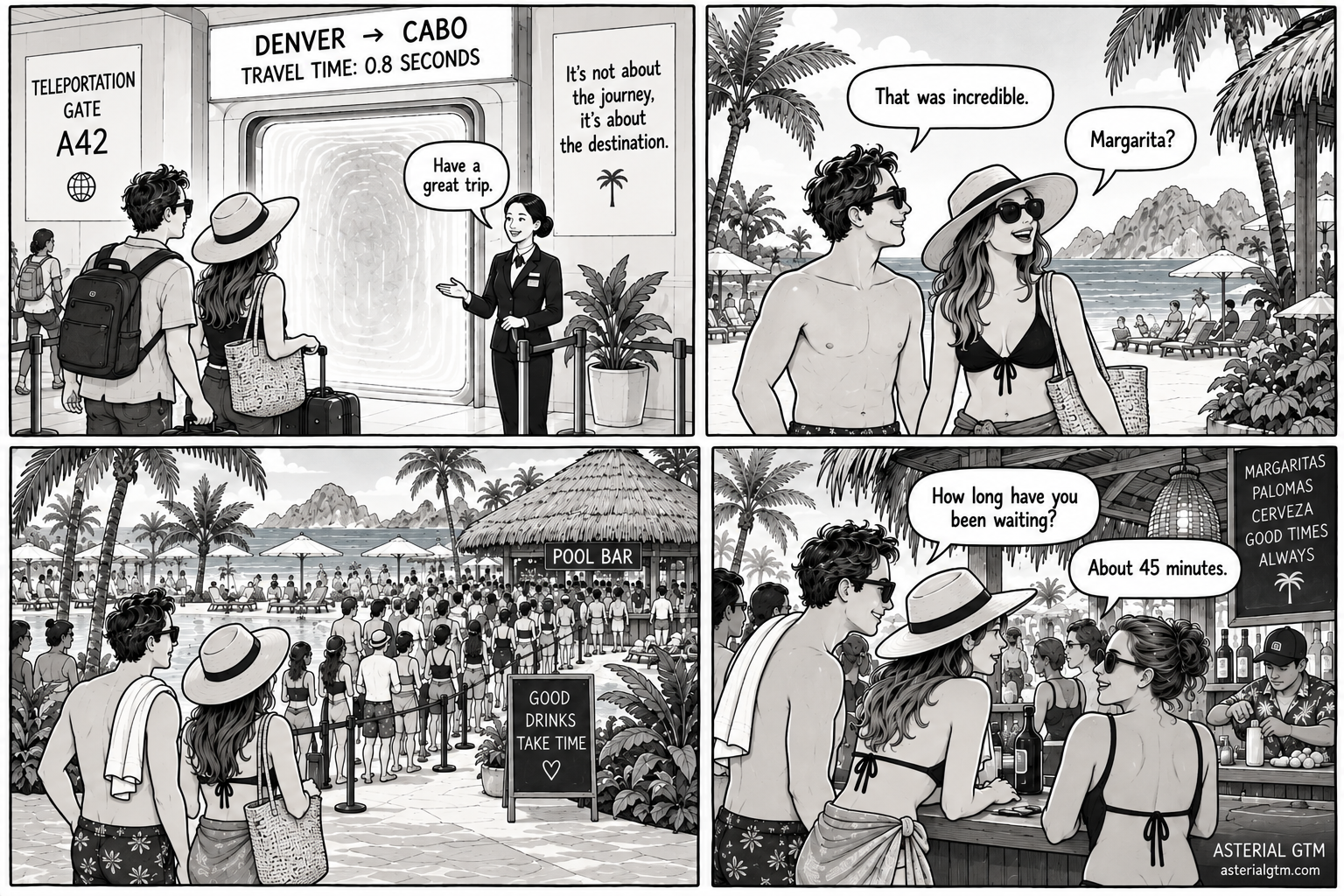
You can make one part of a system almost infinitely fast without making the system fast. Concept and direction by Megan Arnold; image created with ChatGPT.
That's GTM latency: the accumulated time and information loss between a market signal and the organization's coordinated response to it.
AI can compress enormous amounts of execution time without touching the latency between the people, teams and companies doing the executing.
In fact, there's a strange possibility here.
The faster AI makes each of us, the more visible the waiting between us becomes.
A brief that once took me three days might have made a two-week wait feel normal.
A brief that takes ten minutes makes the same two weeks look very different.
This isn't an argument for eliminating agencies, meetings, partners or collaboration. Those relationships often create enormous value.
It's an argument for looking at the whole system.
If AI makes every individual worker dramatically faster while the work still waits in queues, calendars, handoffs and organizational boundaries, we haven't transformed go-to-market.
We've made the spaces between the work easier to see.
