

Organizational Modernization: We Upgraded the Technology. What About the Organization?
There is an enormous conversation happening in technology right now about modernization.
Modernize the data estate. Modernize applications. Modernize infrastructure. Modernize security. Build the technical foundation required for AI.
It makes sense. You can't bolt a fundamentally new technology onto infrastructure built for another era and expect transformation.
But we seem remarkably comfortable doing exactly that with the organization.
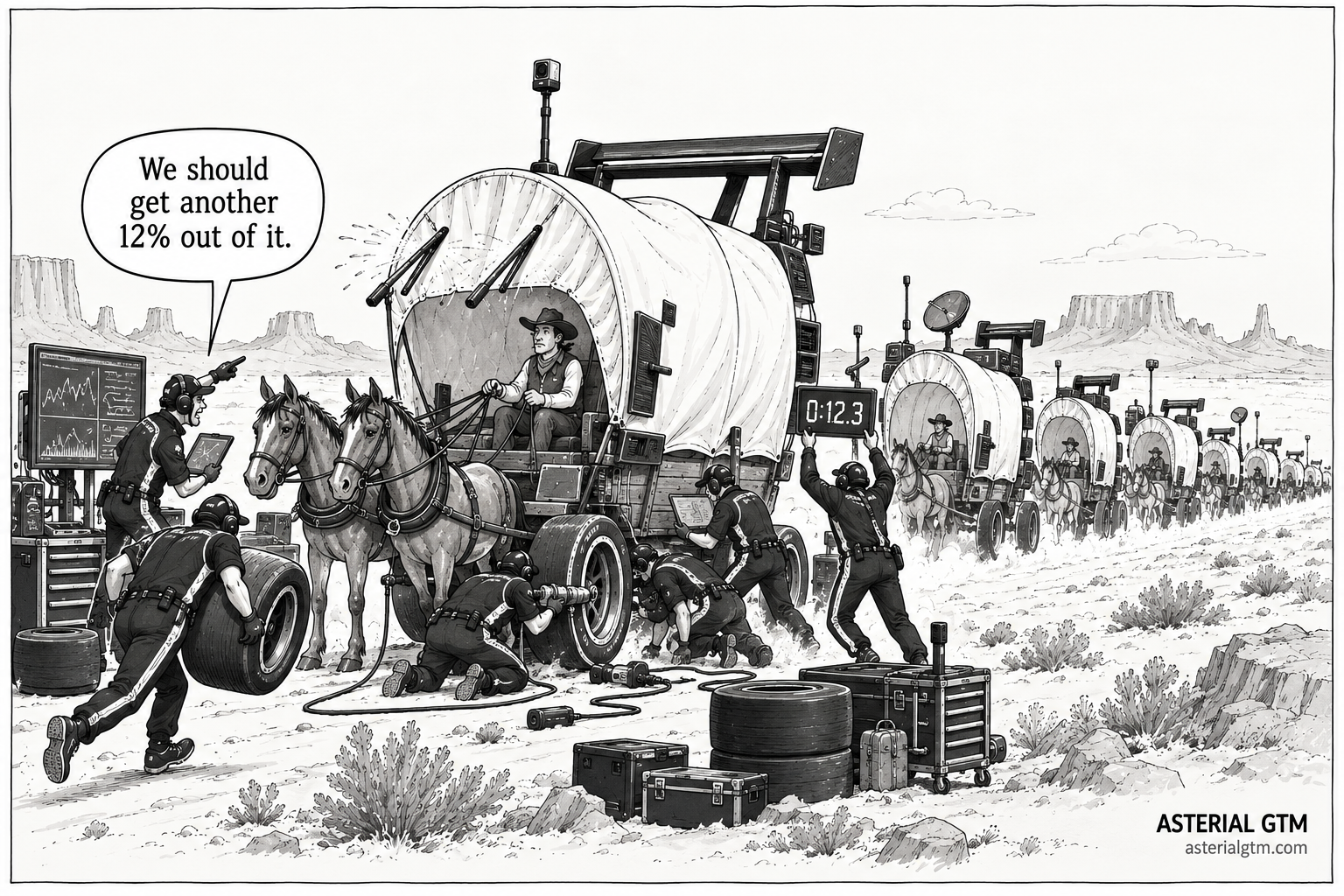
We’re investing enormously in modernizing the infrastructure beneath AI. What happens when the organization running on top of it was designed for a different information environment? Concept and direction by Megan Arnold; image created with ChatGPT.
Many of the basic structures we still recognize inside large companies were developed to solve the information and coordination problems of an earlier industrial economy.
The functional organization grouped people by specialization: engineering with engineering, marketing with marketing, finance with finance. Specialization created expertise and efficiency, but coordinating work across those functions became a management problem.
As companies grew larger and more diversified, the structure evolved.
In 1962, Alfred Chandler's Strategy and Structure documented the rise of the multidivisional organization at companies including DuPont, General Motors, Standard Oil and Sears. Instead of trying to run an increasingly complex enterprise entirely through centralized functions, companies created more autonomous operating divisions, while a central office coordinated, planned and evaluated their work.
Then organizations became more complex along multiple dimensions at once.
Products mattered. Functions mattered. Geographies mattered. Projects mattered.
Enter the matrix.
In 1971, Jay Galbraith described matrix structures as an attempt to capture the advantages of both functional and project-based organizations. His case study is strikingly recognizable today: engineering, manufacturing and marketing needed to coordinate work while maintaining their specialized capabilities. Rules, planning processes, hierarchical escalation, direct contact and liaison roles were all mechanisms for integrating work across those boundaries.
Three years later, Galbraith articulated an idea that I think matters enormously in the age of AI.
Organization design is, in part, an information-processing problem.
As uncertainty increases, the amount of information an organization must process to coordinate its work increases too. Organizations can respond in different ways: create slack, make work more self-contained, invest in better information systems, or create more lateral relationships that allow information to move across the organization.
That was 1974.
The theory doesn't suddenly become wrong because it's fifty years old.
If anything, it gives us the question we should be asking now.
What happens when the information environment changes beyond recognition?
The constraint changed
The modern enterprise doesn't suffer from a shortage of information. It operates inside an almost continuous stream of it.
Customer calls. CRM records. Product telemetry. Emails. Teams messages. Documents. Competitive intelligence. Partner data. Market research. Support tickets. Seller feedback. Meeting transcripts. Usage data. Financial results.
And now AI can synthesize, generate, retrieve and transform much of that information at a speed that would have been difficult to imagine when many of our organizational mechanisms were developed.
A marketer can go from an idea to a campaign brief in minutes, a product manager can interrogate thousands of pieces of customer feedback, a seller can ask a question across a body of organizational knowledge instead of finding the person who knows the answer, a small team can produce work that once required a much larger chain of specialists.
But then that work enters the organization.
It hits the planning cycle.
The functional boundary.
The approval chain.
The meeting cadence.
The regional handoff.
The partner boundary.
The person who needs to be brought up to speed. The other person who has to be brought into the meeting because they own one piece of the decision.
And suddenly we have an extraordinary new information-processing technology moving through an organizational architecture built around very different information-processing economics.
AI is increasing our capacity to act while simultaneously increasing the speed at which the environment changes around us.
The challenge is no longer simply processing more information. It's sensing what changed, understanding what matters, coordinating a response and adapting again before that understanding becomes obsolete.
Our modernizations are falling short
The increase of uncertainty in our markets, our economies, our communities is why I'm increasingly interested in organizational modernization.
Not restructuring for the sake of restructuring. Not declaring hierarchy dead. Not replacing every function with small autonomous teams. And certainly not arguing that decades of organization-design research suddenly stopped applying.
The opposite.
If organizational structures evolved in response to the economics of specialization, coordination, uncertainty and information processing, then a dramatic change in those economics should make us revisit the structures.
What work still benefits from specialization?
What information still needs to travel up a hierarchy?
What decisions actually require consensus?
What should be standardized, and what should remain variable?
What happens when execution can be local while learning becomes shared?
What is the smallest unit of an organization capable of sensing, deciding, executing and learning?
And what organizational infrastructure would allow hundreds of those units to learn from one another without requiring everyone to coordinate with everyone else?
Those aren't primarily questions about AI adoption.
They're questions about organization design.
We are spending enormous energy preparing our technical infrastructure for AI.
We should be asking what kind of organization we're preparing it to run.
