

Partnerships Aren't Symmetrical. Stop Designing Them Like They Are.
One of the most persistent assumptions in partnership design is also one of the most understandable. We expect the other company to look something like ours.
We have a product marketer. Where's your product marketer?
We have regional funding. Where's yours?
We have sellers covering these accounts. Who are their counterparts?
We have a process for this. What's your version?
Sometimes there is an equivalent. Often there isn't.
And then we treat the difference as a problem to solve.
The asymmetry is often the reason the partnership exists.
Different companies should bring different things
Consider the relationship between a hyperscaler and an independent software vendor.
The hyperscaler may want access to the ISV's installed base and customer relationships. The ISV can become a route through which customers consume more cloud.
The ISV may want access to the hyperscaler's marketplace, reach and enormous sales organization. The hyperscaler can become a route through which the ISV reaches more customers.
In an oversimplified version, each company would quite like the other to behave like its channel. Neither is.
So the partnership becomes a continuous negotiation between interests that overlap but do not coincide.
This is not an edge case in ecosystem theory. It is foundational.
Michael Jacobides, Carmelo Cennamo and Annabelle Gawer describe ecosystems as arrangements of distinct but interdependent organizations coordinated without full hierarchical control, with complementarities at the core of why the ecosystem exists.
Adner similarly treats ecosystem strategy as a problem of aligning different actors around a value proposition. Those actors can have different goals, positions and dependencies.
So asymmetry itself isn't the interesting discovery. The interesting question is why our operating models keep trying to erase it.
Organizational symmetry is comforting
Symmetry makes planning easier.
Company A contributes a marketer. Company B contributes a marketer.
Both contribute budget. Both activate sellers.
Both localize. Both report results.
The spreadsheet is beautiful. Reality is less cooperative.
One company has an enormous centralized marketing organization but almost no regional flexibility. Another has regional marketers with autonomy but little centralized support.
One has money. Another has people.
One has deep product expertise. Another owns the customer relationship.
One has an elegant partner program. Another has three extraordinarily committed humans who somehow make everything work.
Culture matters too. Some organizations escalate everything.
Some avoid escalation at almost any cost. Some are chronically under-resourced.
Some are so heavily resourced that coordinating their own participants becomes part of the partnership workload.
A partnership can be all chefs and no line cooks. Or six line cooks waiting for someone to decide what they're making.
A partnership is a continuously splitting strategic atom.
What begins as one executive relationship quickly divides into products, regions, sellers, marketers, funding sources, customer segments, industries and individual people—each with slightly different incentives and constraints.
What looks like a single partnership strategy at the center fractures as it moves toward execution. Each marketer sits inside a different field of global, regional, sales and functional priorities—so by the time two partner marketers meet at the corporate boundary, they may be representing very different systems of strategic gravity.
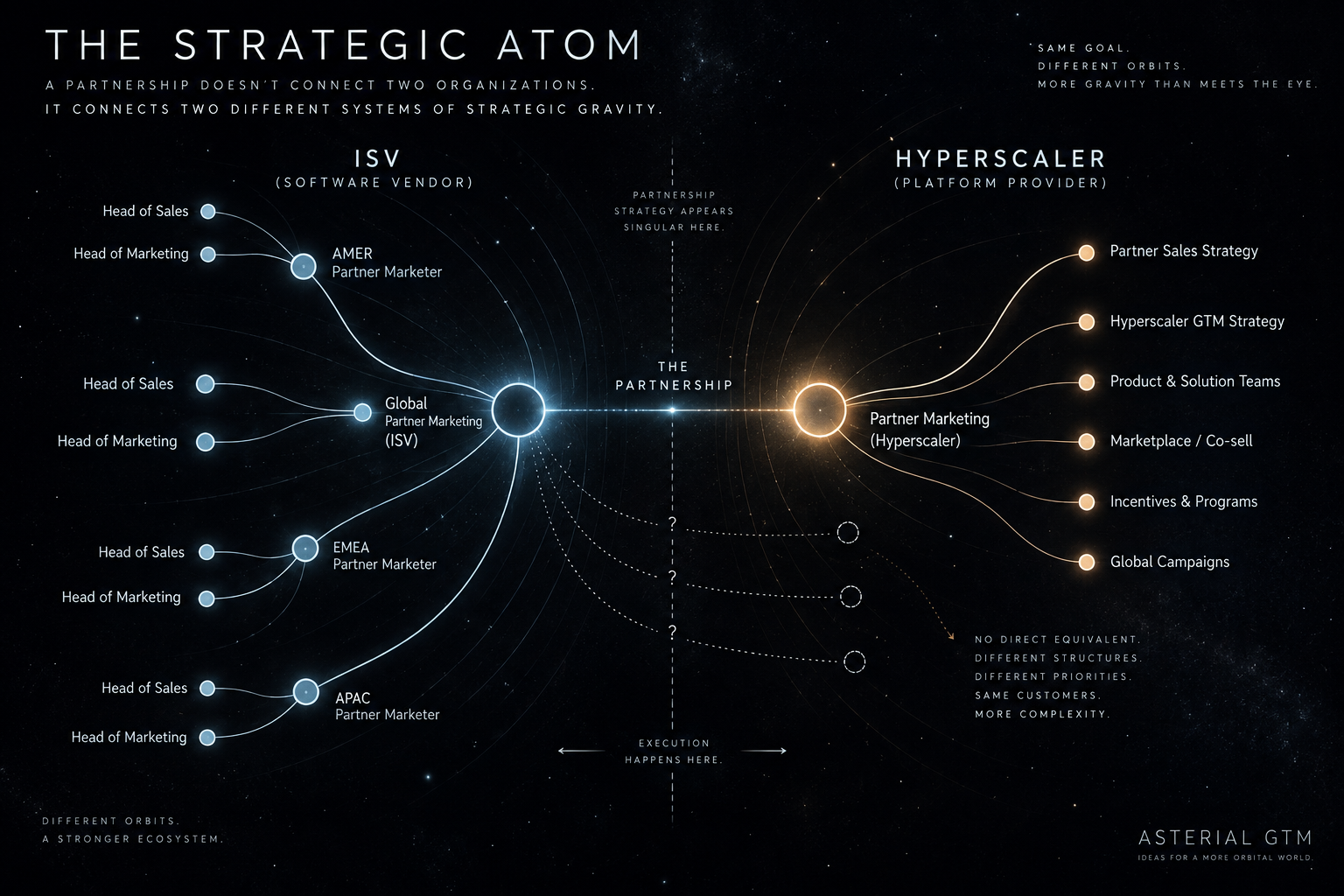
“The Strategic Atom.” A partnership may look singular at the corporate boundary, but strategy fractures as it moves through different organizational structures, priorities and lines of accountability. Concept and direction by Megan Arnold; image created with ChatGPT.
What if we dumped the resources onto the floor?
I've sometimes wondered what would happen if we stopped looking at the participating companies as organizations for a moment.
Imagine dumping every resource available to the partnership onto the floor.
People. Budget. Technical expertise. Customer relationships. Marketplace access. Sales reach. Industry knowledge. Marketing capabilities. Implementation capacity. Data. Executive sponsorship.
Then rebuild an organization around the work that actually needs to happen:
The partnership collectively has a complete organization.
It just doesn't exist as one org chart.
Its resources belong to different companies. They report through different hierarchies. They have different incentives. Different planning cycles. Different systems. Different definitions of success.
And nobody has hierarchical authority over the whole thing.
That's not a failure of partnership management. That's the defining organizational condition of an ecosystem.
Strategy has to survive contact with executability
This becomes particularly important when companies standardize partner programs. Standardization is attractive because bespoke execution is expensive.
Build the campaign. Package the messaging. Create the assets. Send the play to five partners. Scale.
Sometimes that works beautifully. Sometimes the differences between the partners are precisely what make the standardized motion unusable.
The dimensions multiply quickly:
Geography.
Account segment.
Product.
Industry.
Persona.
Partner type.
Customer maturity.
Seller coverage.
Available budget.
Existing relationships.
Suddenly the “program” is an infinite Rubik's cube of possible GTM configurations.
Classical strategy asks which opportunity is most attractive.
Ecosystem strategy has to ask another question:
Can this particular configuration of organizations actually execute it?
An attractive market opportunity that requires regional coverage no participating company has is not necessarily good strategy.
A campaign that assumes localization will happen in three weeks when the operating process requires nine months is not good strategy.
A motion that requires a seller population nobody has the ability to activate is not good strategy.
Executability is part of strategy.
AI may change what asymmetry costs
This is where AI becomes interesting, but not because it will make every partner look the same. It may do the opposite.
Historically, heterogeneity has been expensive. Different partners require different messaging, different account strategies, different enablement, different workflows and different levels of support. So companies standardize.
AI can lower the cost of configuration. That may allow us to design around difference rather than constantly trying to remove it. But the goal shouldn't be perfect customization either. Complexity has a cost, and every ecosystem still needs shared rules, interfaces and governance.
Which things need to be standardized so different organizations can work together—and which things should remain different because the differences create the value?
Ecosystem theory has already told us that interdependent organizations do not need to be identical.
Our operating models need to catch up.
The goal isn't to eliminate asymmetry.
It's to make asymmetry operable.
Research behind this essay
Jacobides, Cennamo & Gawer, Towards a Theory of Ecosystems (2018); Adner, Ecosystem as Structure (2017).
