

The Market Doesn't Know It's Planning Season
American football has a useful feature: the game stops. Often. In planned, consistent ways.
The team huddles. Coaches assess what happened. They choose the next play. Everyone gets an assignment. The teams line up.
Then the work starts again.
A surprising amount of enterprise planning assumes work behaves the same way.
We plan annually. Allocate budgets. Establish priorities. Assign resources. Then execute.
The problem is that the market never agreed to stop playing while we did that.
I work across companies with different fiscal years, planning cycles, budget processes and geographic rhythms. The instinct is often to treat this as a coordination problem:
How do we get everyone aligned to the same plan at the same time?
I'm increasingly interested in the opposite question.
What if they shouldn't be?
Imagine a global campaign launching in the U.S. in July.
Europe has lower capacity in August. Traditionally, we might see EMEA as behind. The rollout isn't synchronized.
Or the U.S. launches first. Customers respond. Sellers learn. Messaging gets tested. Assumptions break.
Then September arrives.
Instead of EMEA launching the same campaign two months late, it launches version two.
The stagger wasn't a bug.
It created a learning opportunity.
Partner ecosystems make the problem even more obvious.
Partner A's fiscal year starts in January. Partner B's starts in July.
Each company has its own annual planning process. So every six months, someone is entering a new year, setting new priorities, reallocating budgets and asking the partnership to plan again.
We experience each of those moments as a reset.
But why?
The partnership doesn't reset because one company's fiscal year does. The customers don't reset. The market doesn't reset. Everything we learned together during the previous six months still exists.
Maybe the useful unit of planning between these companies isn't a year at all.
Maybe it's six months.
Partner A's new planning cycle incorporates what the ecosystem learned during Partner B's previous six months. Six months later, Partner B does the same.
What looks like incompatible planning calendars becomes a shared learning cadence.
Organization design has wrestled with versions of this problem for decades. Jay Galbraith framed organizations partly as information-processing systems: as uncertainty increases, organizations need greater capacity to process information and coordinate work. Research on temporal structuring has similarly examined how organizations create rhythms—deadlines, planning cycles, reporting periods—to coordinate activity.
And of course AI necessarily changes some of the economics underneath those principles. Information can move faster…a lot faster. Analysis can happen faster. What one market—or one company—learns can potentially reach another before it acts.
That doesn't eliminate planning, but it changes what planning can be for.
Instead of asking how every part of an ecosystem can execute the same plan at the same moment, ask:
What actually needs to be synchronized?
Strategy might. Economic constraints might. Product truth and brand might.
Execution? Maybe not. The goal may not be synchronization. It may be coherence without simultaneity.
We keep trying to manage the market like a single football game: predictable opportunities to stop, huddle, call the next play, line everyone up and snap the ball.
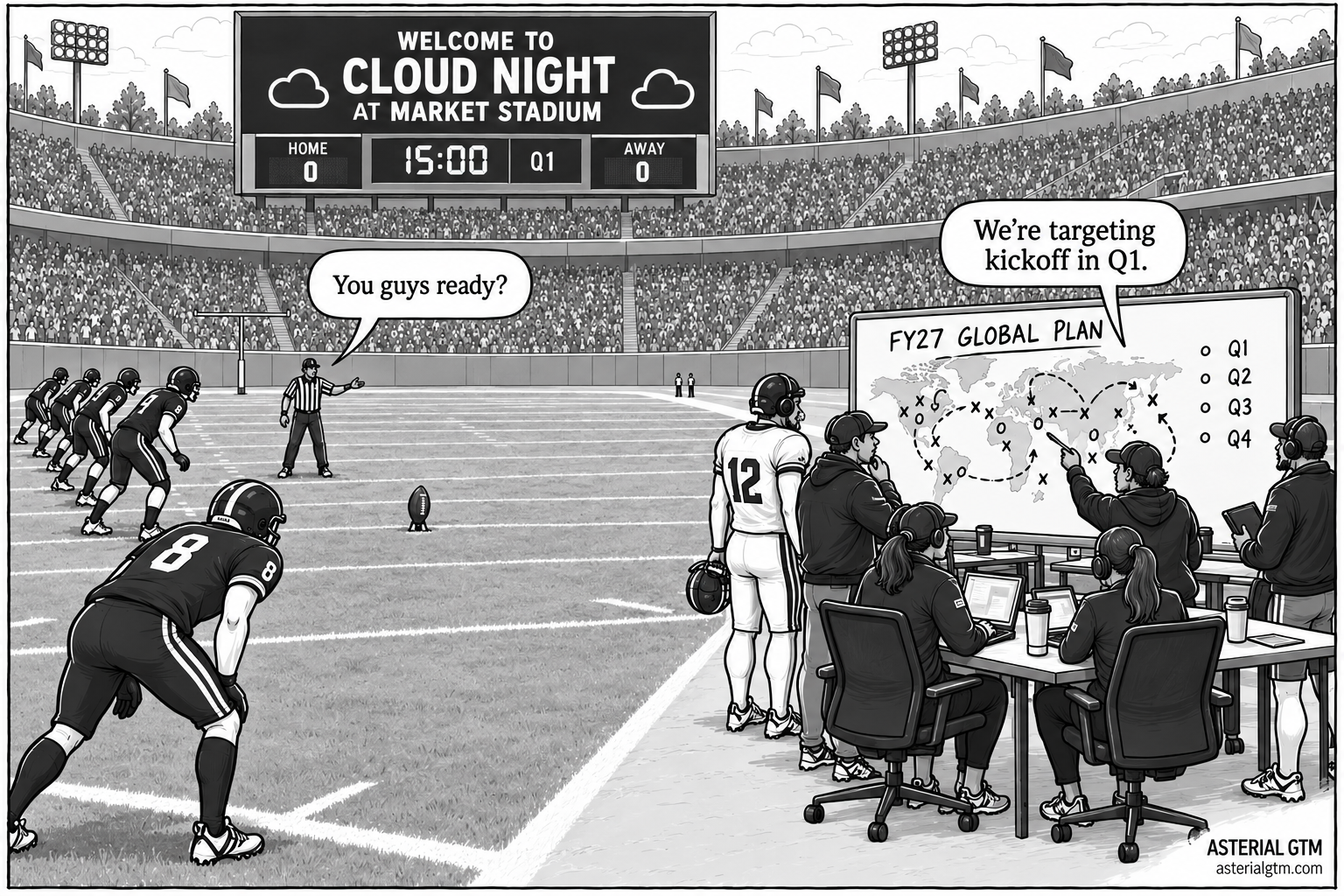
We plan as though the market will wait for everyone to huddle, align and call the next play. It won’t. The opportunity is to build GTM systems that can learn and adapt while the game is already underway. Concept and direction by Megan Arnold; image created with ChatGPT.
But the market looks more like football on a Sunday.
Multiple games are happening at once. They're on different clocks, at different points in the game, with different players, different leaders and different narratives unfolding in real time.
There is no moment when everyone huddles together.
And there is no reason they should.
The challenge isn't getting every team onto the same play at the same time.
It's building a system that can learn across all those games while each team continues to play the one in front of it.
Standardize the principles. Share the learning. Adapt the execution.
The calendar isn't the strategy. It's a constraint the strategy should exploit. Why should the corporate fiscal year should be the natural unit of time for work that crosses corporate boundaries at all?
