

The Market Moves Faster Than the Meeting Invite
The slowest part of partner GTM is often surprisingly mundane. Hint: it’s the calendar.
You have an opportunity. The companies agree it's worth pursuing. Now you need product, sales, marketing, partner teams and perhaps another company involved.
So the coordination begins:
Can everyone do Thursday?
No.
Next Tuesday?
Someone is traveling.
The following week?
There is a sales kickoff.
Eventually, everyone gets on the call. And while we've been negotiating with Outlook, the market has continued operating.
Markets don't wait for organizational alignment
Technology ecosystems are constantly being reconfigured by events no joint GTM plan controls.
An acquisition changes a partner's economics.
A licensing change suddenly makes migration urgent.
A material shortage affects product availability.
A regulation changes what customers can buy.
A political event changes the conversation around sovereignty.
A cloud provider reorganizes its sales territories.
Compensation changes.
A product slips.
A competitor launches.
The kaleidoscope rotates.
And the GTM motion designed for the previous configuration may no longer make sense.
Management research has spent decades studying a version of this problem.
David Teece's work on dynamic capabilities describes the organizational capacity to sense opportunities and threats, seize opportunities, and reconfigure resources as circumstances change. Importantly, those capabilities aren't simply a matter of executives recognizing that something has happened. They depend on processes, structures, decision rules and organizational disciplines that make adaptation possible.
Research on organizational reconfiguration makes the same underlying point: adaptation requires firms to be able to redeploy and recombine resources rather than treating organizational structure as fixed.
Ecosystems make this harder.
Because the resources being reconfigured don't all belong to the same organization.
Agreement isn't alignment
This is one reason I've become suspicious of the phrase strategic alignment. I've participated in plenty of meetings where everyone was strategically aligned.
“We need to accelerate pipeline.” Absolutely.
“Pull more deals forward.” Sounds great.
“Drive consumption.” Also great.
Until you get one level lower. A company built around traditional infrastructure revenue may benefit economically from pulling a transaction into the current quarter. A cloud business may care much more about whether the customer deploys and consumes the service over time.
Both companies can enthusiastically agree that they want to “accelerate growth.” They have not necessarily agreed on the behavior the system should optimize.
Strategic alignment often isn't alignment. It's agreement at a level of abstraction where the contradictions haven't surfaced yet.
Adner's ecosystem research makes a related distinction. Ecosystem participation isn't enough; the actors required to produce the value proposition must align around their positions and activity flows even though they may have different goals. The thing is….this takes a lot of time.
The opportunity has a clock
I've seen joint solutions that everyone believed in. Leadership supported them. The value proposition made sense. The technology worked. What didn't exist was a credible GTM system.
Who are the target accounts?
Which sellers own them?
Who leads?
What's the message?
Have the sellers been enabled?
Who funds demand generation?
Where do leads go?
Who follows up?
Nobody owned the whole motion, and I wasn't willing to spend demand-generation money until there was a credible mechanism for converting demand into action. We never got there.
Not because the strategy was obviously wrong, but because the organization couldn't become executable before momentum disappeared.
That distinction has led me to a concept I've started calling GTM latency.
GTM latency is the time between recognizing a market opportunity and becoming operationally capable of pursuing it. The exact definition will need refinement. But the underlying relationship is simple:
If the opportunity window stays open longer than the system takes to reconfigure, the opportunity is executable.
If the system takes longer to reconfigure than the opportunity remains valuable, the opportunity decays while the companies coordinate.
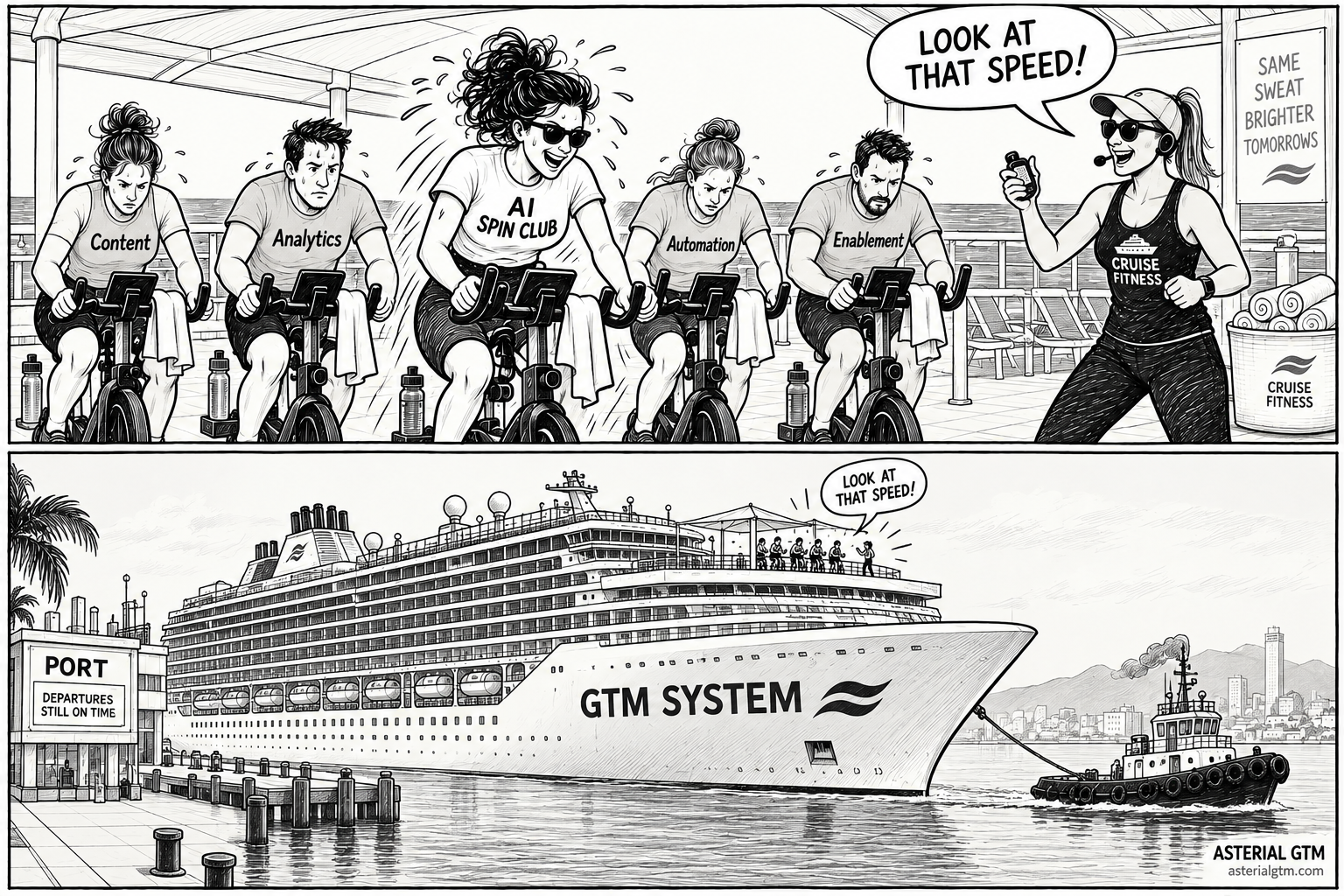
“Look at That Speed!” AI can make individual parts of GTM move dramatically faster without increasing the speed of the system carrying them. Concept and direction by Megan Arnold; image created with ChatGPT.
Sometimes the fastest motions barely look like programs
Some of the fastest partner GTM I've seen has been almost guerrilla-style.
A technical conference is coming up. A handful of engineers and sellers are genuinely excited about a customer problem. They find several compatible partners. They assemble something in six or eight weeks.
The messaging isn't produced through an elaborate centralized process. The people closest to the technology help write it. The graphics get made. The sellers care. The engineers care. Everyone knows why they're there.
And it works.
That isn't an argument against professional marketing or operating discipline.
It's evidence that motivation, ownership and proximity to the work can dramatically reduce coordination latency.
The opposite happens too:
I've watched three companies try to approve one piece of joint collateral when no single person on Earth technically had authority over the integrated object.
Eventually, you get three separate approvals and someone takes responsibility for treating them as one.
The work has an owner-shaped hole.
Speed is an organizational capability
We tend to talk about speed as though it means people working faster. AI certainly makes that possible.
Content can be created faster. Analysis can happen faster. Account research can happen faster. Plans can be generated faster.
But none of that necessarily means the system can move faster.
The more interesting measure may be:
How quickly can this ecosystem translate strategic intent into coordinated action—and reconfigure when the world changes?
Because the market keeps rotating while the operating model schedules the meeting. Eventually we capture the opportunity. Sometimes.
Other times we're doing a floppy seal shuffle across a rocky beach and hoping the opportunity is still there when we arrive.
Research behind this essay
Teece, Explicating Dynamic Capabilities (2007); Karim & Capron, Reconfiguration: Adding, Redeploying, Recombining and Divesting Resources and Business Units (2016); Adner, Ecosystem as Structure (2017). SMS
