
Nobody Sees the Market
Several years ago, I was working with an alliance manager in Europe who was pushing hard for more investment in our partner ecosystem. His argument made sense.
The market was heavily partner-driven. If we wanted to grow our cloud business there, we needed campaigns with the partners who already had the customer relationships and routes to market.
My response was also pretty simple: show me how they get paid.
At the time, there wasn't a clear enough path for many of those partners to transact the cloud offers we wanted them to market. I had finite marketing dollars. There were plenty of things we could fund that had a clear path from campaign to transaction. So partner campaigns stayed relatively low on my priority list.
For a long time, I thought of disagreements like this as alignment problems. Someone needed more context. Someone didn't understand the strategy. We needed better data, clearer priorities, another conversation.
But neither of us was missing the point: we were seeing different points.
He could see something I couldn't see as clearly: how important the partner ecosystem was to the way customers in that market actually bought technology.
I could see something he couldn't see as clearly: the constraint created when marketing investment had no reliable commercial path behind it.
We were looking at the same market, but we were looking at it from different positions inside the system (aand everyone does this).
A seller sees customer objections, a product manager sees adoption and product gaps, a marketer sees audience behavior and demand, a partner manager sees ecosystem dynamics, finance sees the economics, operations sees where execution breaks.
Each perspective is incomplete, but that doesn't make it wrong. Research has been telling us versions of this for decades.
Studies of the hidden-profile problem have shown how groups can possess all the information needed to make a good decision while still struggling to integrate information that is distributed across individual members.
Research on knowledge boundaries has shown that different functions don't merely possess different information. They can interpret knowledge differently because they have different expertise, objectives and ways of working.
And research on absorptive capacity suggests that an organization's ability to recognize and use new knowledge is distributed across the capabilities of its people.
In other words:
Nobody sees the market. Everybody sees the market from somewhere.
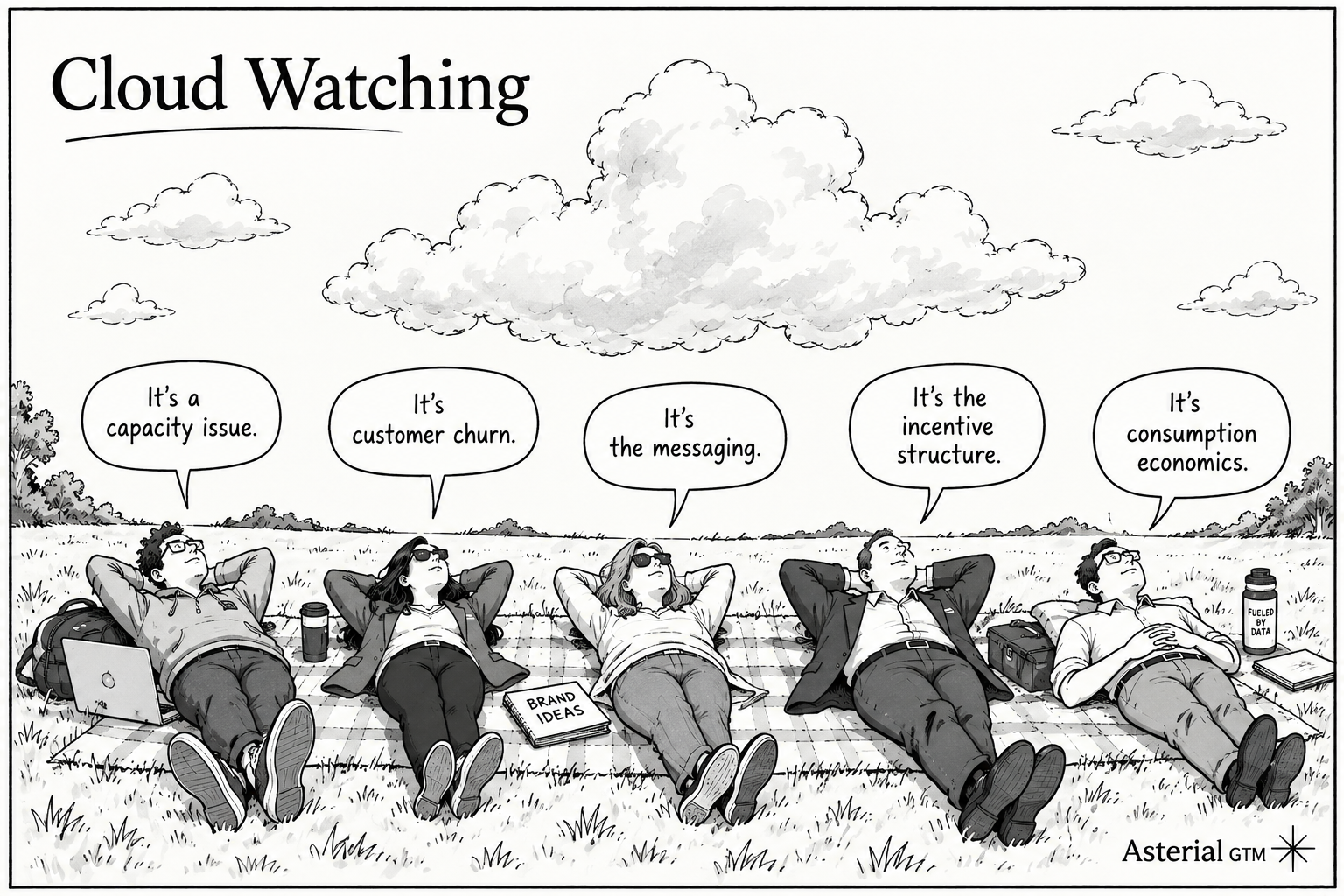
Same cloud. Different diagnosis. Where we sit shapes what we see—and organizations need those different perspectives more than they need everyone to see the same thing. Concept and direction by Megan Arnold; image created with ChatGPT.
That's different from saying organizations need a better “single source of truth.” Sometimes two people can have excellent data and still disagree. Because data doesn't eliminate position.
Different roles create different objectives. Different incentives make different risks salient. Different responsibilities expose people to different parts of the system.
Everyone sees the bottleneck closest to where they sit.
The interesting question for AI, then, isn't simply whether it can give everyone more information.
It's whether it can help an organization see across positions.
Can it surface the observations a seller is hearing repeatedly from customers?
Can it connect those observations to what product teams are seeing in usage?
Can it show the marketer that the partner manager is encountering a commercial constraint in one market that doesn't exist in another?
Can it preserve disagreement long enough for us to understand why it exists rather than immediately summarizing it away?
Because different perspectives aren't organizational noise to eliminate.
They're information the organization should learn to use.
Maybe the goal isn't a single version of the truth.
Maybe it's an organization capable of seeing the truth from more than one position.
