

We Rebuild the Spacecraft for Every Joint GTM Campaign
Three Products Work as One. We Rebuild the GTM Around Them Every Time.
We Rebuild the Spacecraft for Every Joint GTM Campaign
Every joint GTM campaign begins by building a spacecraft.
In astrophysics, Lagrange points are locations created by the gravitational relationship between two large bodies. A spacecraft operating near one of these points can hold a useful position with relatively little energy. Some Lagrange points are more stable than others. Near the less stable ones, the spacecraft needs regular station-keeping maneuvers to keep from drifting away.
Partner ecosystems create similar points of leverage. Two or more companies align around a customer need, a joint solution, a group of accounts, or a commercial opportunity. A campaign gives that alignment a mission. To carry it out, the partners need an operating system capable of moving customer context, decisions, work, and accountability across company boundaries.
That operating system is the spacecraft.
And in much of the ISV ecosystem, we build a new one for nearly every mission.
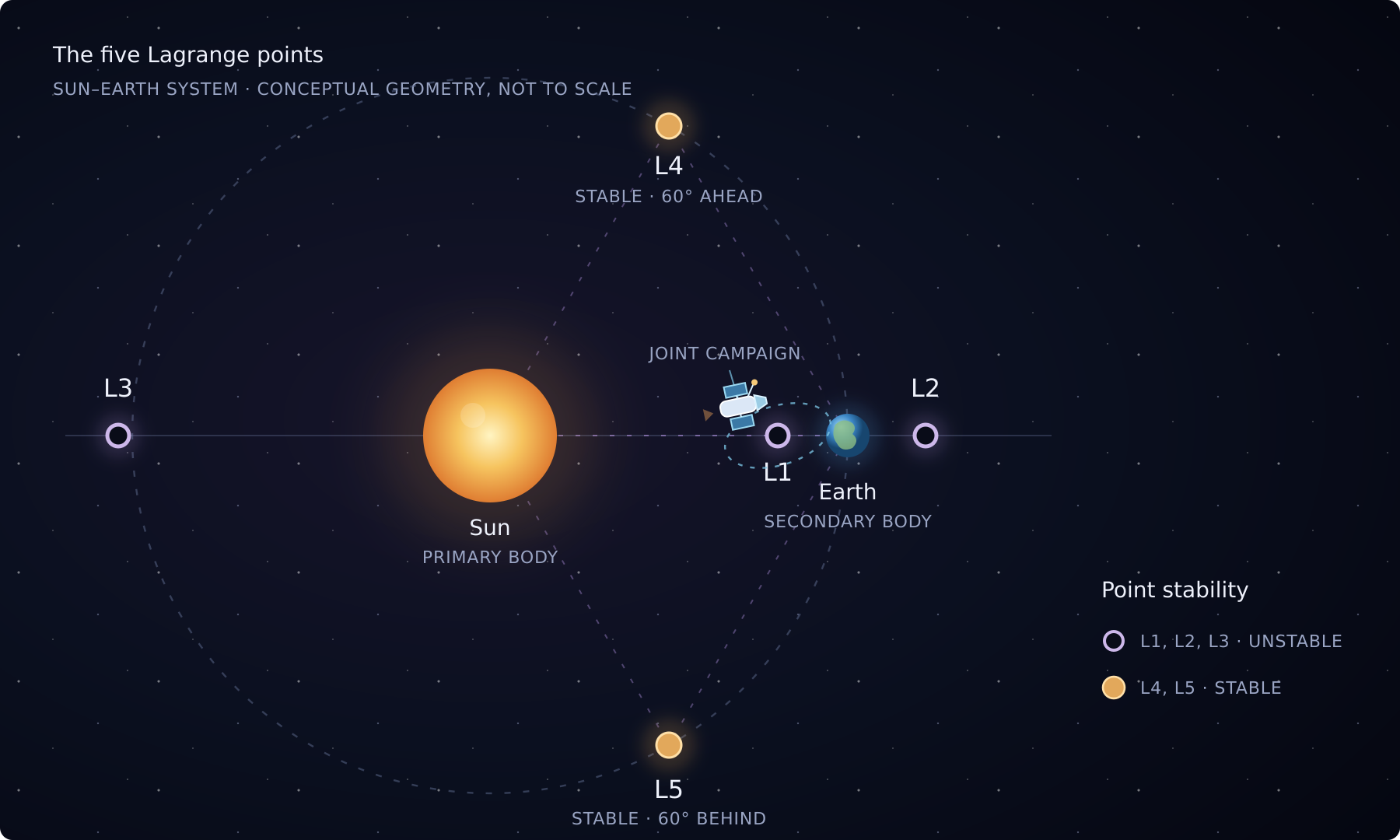
The five Lagrange points in the Sun–Earth system, with a joint campaign depicted station-keeping near unstable L1. Conceptual illustration, not to scale. Illustration by Megan Arnold, created with AI assistance using ChatGPT.
The payload is ready before the spacecraft
Three companies’ product teams engineer a joint solution. Three products now work together seamlessly. Then the customer tries to buy it.
The products function as one. The customer still has to navigate three companies.
Each company has its own account priorities, sales organization, marketing systems, qualification criteria, commercial model, and way of measuring success. Product integration does not automatically establish which company should introduce the solution, whose sellers should pursue it, where customer responses should go, or who owns the customer after the contract is signed.
Those decisions often begin after the technical work is complete. By then, the companies may have announced the partnership, established revenue expectations, and committed funding to a launch.
The payload is sitting on the ground. The teams still have to build the vehicle that will carry it to market.
We already know what the spacecraft needs
There is little about a multipartner GTM motion that is operationally unfamiliar. A company taking its own product to market selects an audience, identifies buyers, develops an offer, generates demand, captures engagement, qualifies responses, engages sellers, progresses opportunities, transacts, implements, and drives adoption.
The same functions exist when two, three, or four companies participate. Their ownership is distributed.
One company may host the campaign and capture the initial engagement. Another has the deepest product knowledge and is best equipped to qualify the need. A third has the strongest customer relationships and controls access to the buyers. The transaction may happen through a marketplace, implementation may belong to a services partner, and adoption may ultimately determine whether another partner recognizes revenue.
Every joint motion therefore needs some version of the same core machinery:
- Account alignment
- Seller mapping
- Customer identity and context
- Lead capture, qualification, and routing
- Opportunity ownership
- Shared visibility
- Commercial and post-sale handoffs
- Governance, attribution, and measurement
The specific partners, solution, audience, and route to market change. These requirements remain remarkably consistent.
Yet teams routinely assemble them from scratch. They create a new spreadsheet to reconcile the account lists and another to map the sellers. They establish a new meeting cadence, intake process, lead-routing agreement, reporting method, and set of definitions. Legal and privacy questions are worked through for that particular combination of companies. The people involved learn how to work together while the work is already underway.
Each campaign becomes a prototype.
A strategy for 5,000 accounts becomes 5,000 flight plans
At the strategy level, three companies may agree on 5,000 target accounts. They identify overlap using firmographic criteria, product usage, cloud consumption, purchase intent, or other signals. The list gives the partnership a market, a shared direction, and enough scale to justify investment.
But 5,000 accounts do not create one motion. They create 5,000 different versions of it.
In one account, the platform company may have the strongest executive relationship, the software company may already have an active opportunity, and the services partner may have no presence. In another, the services partner may be leading a transformation program while the other two companies are trying to gain access. One account may be ready to buy. Another may need education. A third may already use all three products but have no reason to think of them as one solution.
The portfolio strategy establishes where the mission will operate. At the account level, the system still has to resolve the customer need, existing relationships, product footprint, opportunity maturity, assigned sellers, commercial incentives, and best next action.
Matching company names across three lists is only the beginning. The partners need a shared reason for pursuing each account. They also need a way to identify the relevant people and determine who should act.
Doing that manually for ten accounts is possible. Doing it for 5,000 is an operating model.
This is where claims of scale tend to exceed the infrastructure supporting them. The strategy is built for thousands of accounts. Execution still depends on a small number of people resolving the motion one account at a time.
Campaigns create a temporary flight system
A campaign gives the partners a shared audience, budget, deadline, customer story, set of deliverables, and reason to meet. People are named. Approvals are pursued. Reporting is assembled.
For a limited period, the campaign creates an operating structure that the companies do not otherwise share.
That structure can place the joint motion near a useful point of equilibrium. Customer need, partner capabilities, seller interests, and commercial opportunity align well enough for the companies to act together.
The position rarely holds itself.
A partner marketer reconciles the account lists. An alliance manager tracks down the sellers covering each account. Someone carries customer context between systems, rebuilds the performance view, follows up on overdue actions, resolves an attribution disagreement, and reminds the teams who committed to the next step.
These are the campaign’s station-keeping maneuvers. They prevent the motion from drifting back into the separate priorities and systems of the participating companies.
The fuel is time, attention, budget, institutional knowledge, and political capital.
Some campaigns require modest corrections. The partners already have strong relationships, complementary incentives, clear ownership, and a familiar commercial path. Others need near-constant intervention. Remove one partner manager or stop the weekly meetings, and the shared motion begins to disappear.
That gives us a useful question for any joint campaign:
How much of the mission’s energy reaches the customer, and how much is consumed keeping the spacecraft in position?
A campaign can generate pipeline and still be structurally difficult to repeat. Its results may justify the investment while its station-keeping requirements prevent it from scaling.
The launch window keeps moving
Building the spacecraft takes time, and the mission does not wait.
The customer has a budget window, a current priority, and a problem they are trying to solve now. Another vendor may already be in the account.
The market is moving too. Products change. Competitors act. Regulations shift. New capabilities alter what customers expect. In a market moving as quickly as AI, a joint solution can lose its novelty while the participating companies are still deciding how to take it to market.
The partners have organizational clocks of their own. Each company operates through planning cycles, funding cycles, legal reviews, sales territories, and leadership priorities. The people who designed the original motion may change roles before the campaign reaches the field.
A lead-routing agreement finalized three weeks after launch cannot recover the customer interest lost during those three weeks. A target account list completed after territories change has to be mapped again. A commercial path agreed after the customer’s budget closes belongs to a mission whose launch window has passed.
Opportunity value decays while companies coordinate.
We tend to measure partner ambition through investment, pipeline targets, and the number of accounts in the plan. The time required to convert a joint decision into coordinated action may tell us more about the system’s ability to produce revenue.
The customer can feel the course corrections
Customers will never see most of the machinery holding the campaign together. They experience its instability.
They repeat information because context did not survive a handoff. They receive outreach from two partners while waiting to hear from the third. They hear slightly different versions of the value proposition. They struggle to understand who owns the next step. They discover late in the buying process that the path to implementation was never fully aligned.
The customer journey is where the internal physics of the ecosystem becomes visible, much as celestial bodies reveal the otherwise invisible forces acting between them.
When the journey fragments, the customer absorbs the coordination cost. That cost appears as delays, uncertainty, repeated work, and increased risk. For the partners, it appears as slower pipeline creation, lower conversion, longer sales cycles, delayed implementation, weak adoption, and missed expansion.
Three individually strong companies can create a collective experience that feels surprisingly fragile.
The next mission starts from scratch
At the end of a campaign, the temporary flight system often disappears.
The spreadsheets stop being updated. The meeting cadence ends. Sellers move to other priorities. The people who understood how the pieces fit together carry that knowledge into their next project or role. Results are reported back into separate company systems, each preserving a different version of what happened.
Then another joint solution or campaign appears, and another team begins assembling the same operational components.
The new mission may have a different payload, trajectory, and partner configuration. It will still need account alignment, seller mapping, customer context, qualification, routing, shared visibility, ownership, governance, and measurement.
We know what a spacecraft requires. We know where the station-keeping burden tends to fall. We know that the time spent building and correcting it consumes part of the opportunity it was created to pursue.
So why does every multipartner mission still begin in a new spreadsheet?
