
Division of Labor. Division of Learning.
The division of labor is one of the foundations of the modern organization.
Engineering builds the product. Sales talks to customers. Marketing creates demand. Finance understands the economics.
Specialization makes us extraordinarily good at our piece. But it has a side effect:
When we divide the work, we also divide the learning.
The seller learns why customers hesitate. The engineer learns where the product breaks. The marketer learns which messages resonate. The regional team learns something headquarters can't see.
Collectively, the organization might know a lot. Individually, none of us does.
Research on transactive memory systems has long examined this dynamic: teams develop differentiated expertise alongside an understanding of “who knows what.” But organizations are often much better at dividing the labor than recombining the learning.
We try with meetings, dashboards, QBRs, repositories and postmortems. Still, much of what people learn remains attached to the person who learned it.
Which makes me wonder if one of AI's most interesting organizational possibilities has little to do with doing our jobs for us.
What if it helps us learn from each other's jobs?
The breakthrough isn't making everyone know everything.
The organization already knows more than any individual inside it.
The opportunity is making more of that knowledge available to everyone else.
It's connecting what was previously separate.
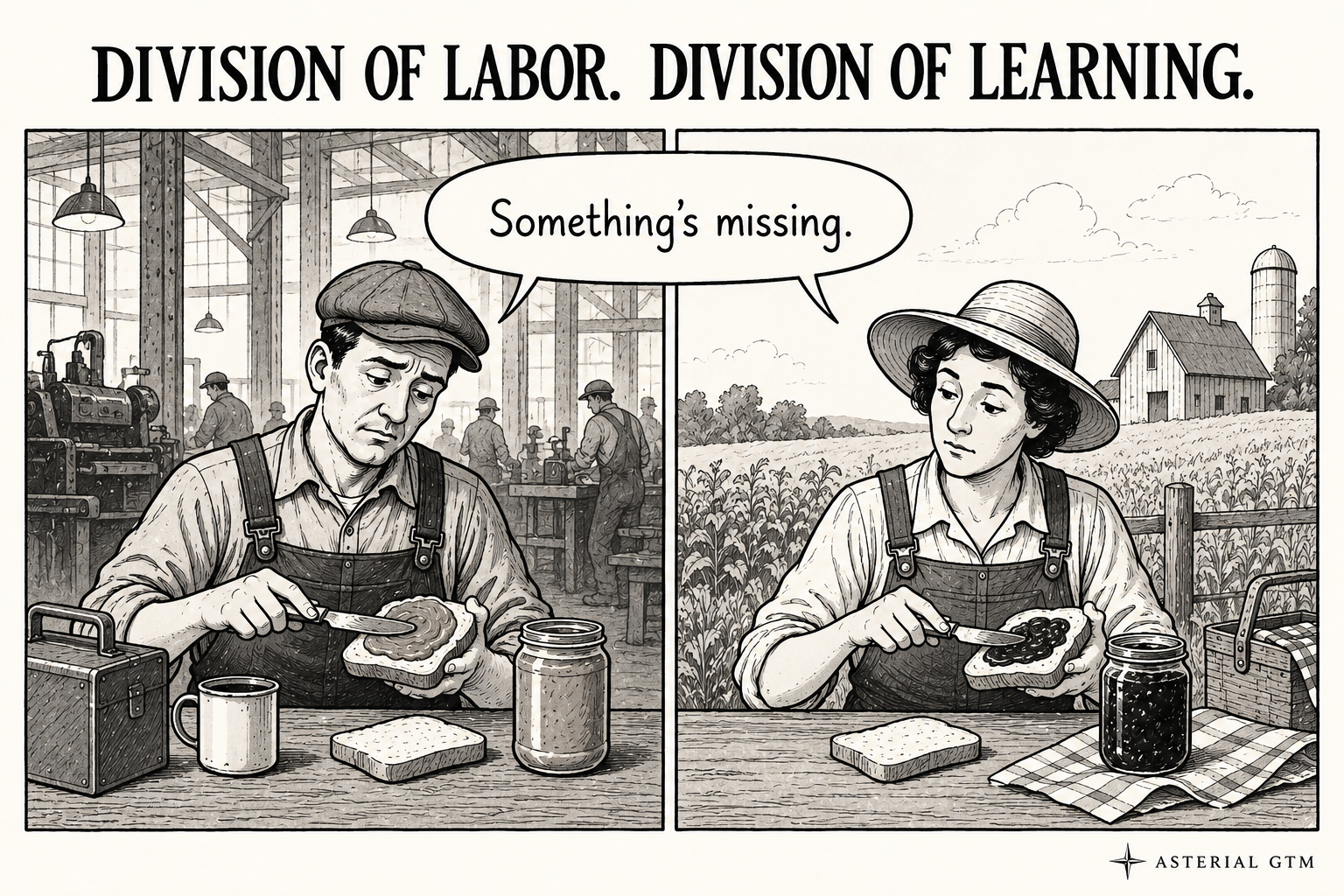
Specialization makes us better at our piece of the work. But the breakthrough may live in connecting what each of us learns. Keep the division of labor. Reduce the division of learning. Concept and direction by Megan Arnold; image created with ChatGPT.
That's increasingly how I think about organizations.
Different work produces different observations. We don't want to eliminate that. We want those observations to travel.
What did the seller learn that product should know? What did France discover that Germany hasn't encountered yet? What did one partner try that another could build on?
Keep the division of labor. Reduce the division of learning.
