

The Best Seat in the House is in the Partner Org
I’m measured, in part, on partner-referred opportunities and pipeline.
That makes perfect sense if you think of a partner primarily as a channel: did the relationship produce demand? Did that demand become pipeline? Did it become revenue?
It makes less sense when the partner is an independent software company sitting inside a much larger technology ecosystem.
Because after years working in partner organizations, I’ve become convinced that one of their most valuable outputs is something we barely measure at all.
Partners see things.
They see which product launches make sense to customers and which require months of explanation. They see when a technically compelling integration fails to produce a compelling customer story. They see which sales motions actually reach the field and which remain beautiful PowerPoint slides.
They see how customer priorities differ across regions, how competitors change conversations, how organizational structures accelerate or constrain execution, and where theoretically elegant GTM models break when they encounter actual buyers.
And, critically, they see many versions of these things.
A product team sees deeply into its product. A sales organization sees deeply into its accounts. A regional organization sees its market. A partner organization can sit at the intersection of all of them—and then repeat that experience across companies.
That should be an extraordinary learning system, but we don’t operate it like one.
Exposure isn't learning
Organizational researchers have been thinking about this distinction for decades.
In 1990, Wesley Cohen and Daniel Levinthal introduced the concept of absorptive capacity: a firm's ability to recognize the value of external information, assimilate it and apply it commercially. Importantly, they distinguished organizational absorptive capacity from the knowledge possessed by any one individual. An organization does not become capable of learning simply because someone inside it noticed something important.
Alliance research makes the point even more directly.
Prashant Kale, Jeffrey Dyer and Harbir Singh found that companies with a dedicated alliance function designed not only to coordinate alliances but to capture and disseminate alliance knowledge reported greater alliance success. Later work by Kale and Singh identified a more explicit alliance-learning process: articulating, codifying, sharing and internalizing what an organization learns through alliances.
That distinction matters.
Because partner organizations can be extraordinarily information rich while remaining learning poor.
I can observe the same problem across four partners. Someone else can see it across another five. A regional team may discover an approach that works remarkably well. A seller may understand why a joint solution suddenly resonates with customers. A campaign may dramatically outperform another.
But unless those observations are captured, compared, interrogated and eventually allowed to change something, the organization hasn't necessarily learned.
The people have.
We are very good at asking what happened
This becomes especially visible when something works.
Someone runs a great campaign. The natural question is: How did you do it?
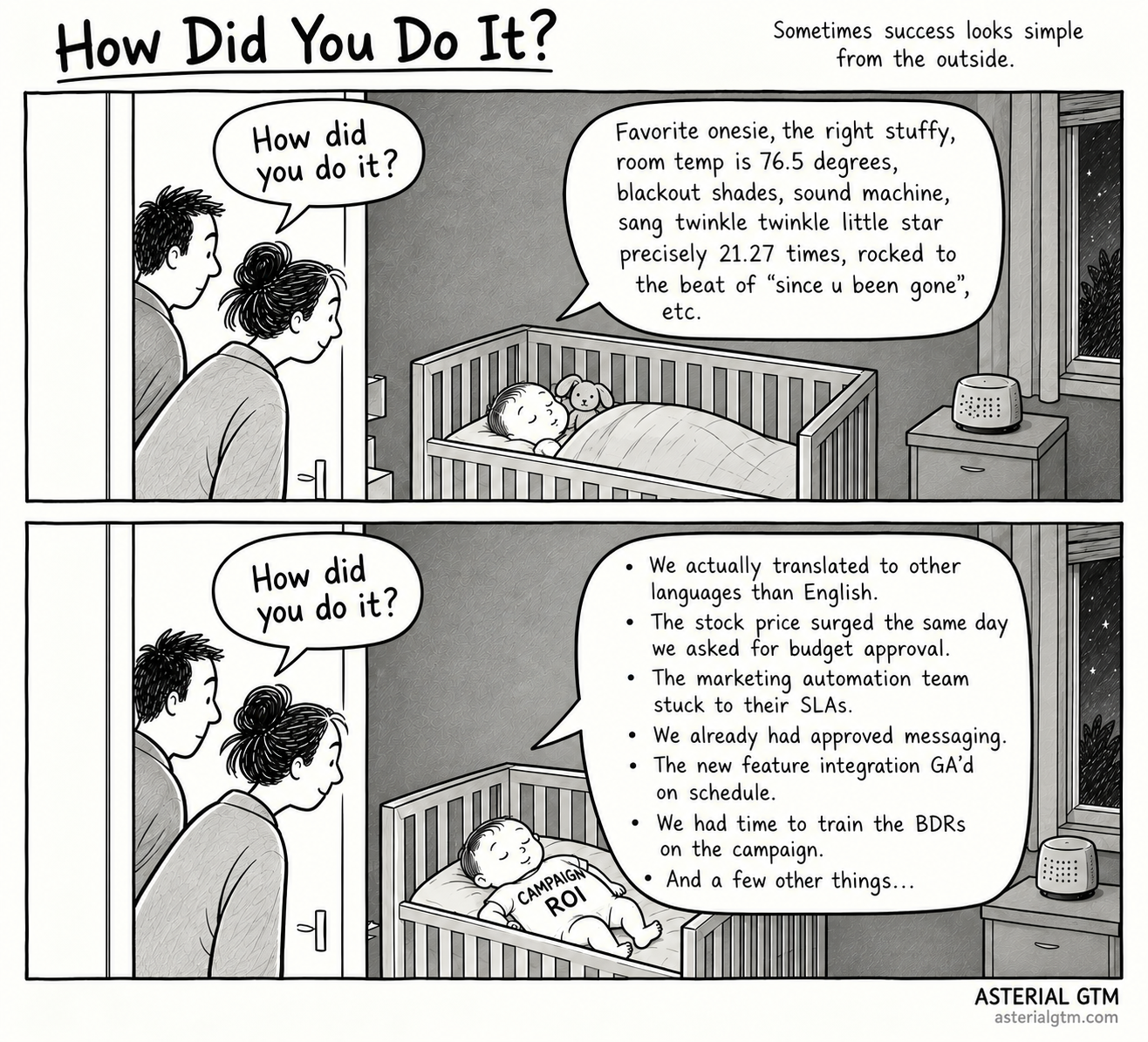
“How Did You Do It?” Success often looks repeatable only after we strip away the conditions that made it possible. Concept and direction by Megan Arnold; image created with ChatGPT.
So we document the audience, messaging, tactics, channels, budget and results. We turn the campaign into a case study. Maybe we call it a best practice. But success is rarely that clean.
Maybe the campaign was proposed just as the partner's stock price surged and suddenly executives were willing to fund something they had delayed for months.
Maybe the integration became generally available exactly when promised.
Maybe the approved messaging already existed.
Maybe marketing automation actually hit every SLA.
Maybe there was enough time to train the BDRs.
Maybe the regional team translated the campaign rather than waiting nine months for a centralized localization process.
The campaign worked.
But which parts of what happened constitute the repeatable capability?
That's a harder question. And at ecosystem scale, it becomes a fascinating one.
A large technology company may have hundreds or thousands of external relationships generating observations about customers, products, markets, competitors, sales motions and organizational behavior.
Imagine being able to interrogate that accumulated experience longitudinally.
When did our expectations about this market change?
Which assumptions repeatedly turned out to be wrong?
Which early signals predicted successful joint motions?
Which decisions looked right at the time but proved costly later?
What conditions were consistently present when something worked?
Which problems keep appearing across completely unrelated partners?
Those are not pipeline questions: they are learning questions.
The ecosystem as an observation network
This is where I think the role of partner organizations gets more interesting than the traditional channel model suggests. The ecosystem isn't only a route through which companies reach customers.
It is also an enormous observation network, and AI makes that possibility much more consequential.
Historically, the cost of capturing and synthesizing thousands of messy observations was prohibitive. The knowledge lived in people's heads, email, meeting notes, decks, CRM fields, partner plans and eventually whatever they remembered when someone asked.
AI dramatically changes the economics of making that information searchable and comparable, but AI can't learn from organizational experience the organization never captured. And it can't decide which observations should alter strategy, funding, product decisions or operating models unless there are mechanisms through which learning can become action.
That part is organizational design.
So perhaps we should expand what we mean when we talk about the performance of an ecosystem.
Of course I want to know what it sold, but I also want to know what it taught us, because the best seat in the house isn't valuable because it reveals a single winning formula.
It may be valuable because it gives us enough observations to stop pretending there is only one.
Research behind this essay
Cohen & Levinthal, Absorptive Capacity: A New Perspective on Learning and Innovation (1990); Kale, Dyer & Singh, Alliance Capability, Stock Market Response, and Long-Term Alliance Success (2002); Kale & Singh, Building Firm Capabilities Through Learning (2007).
